
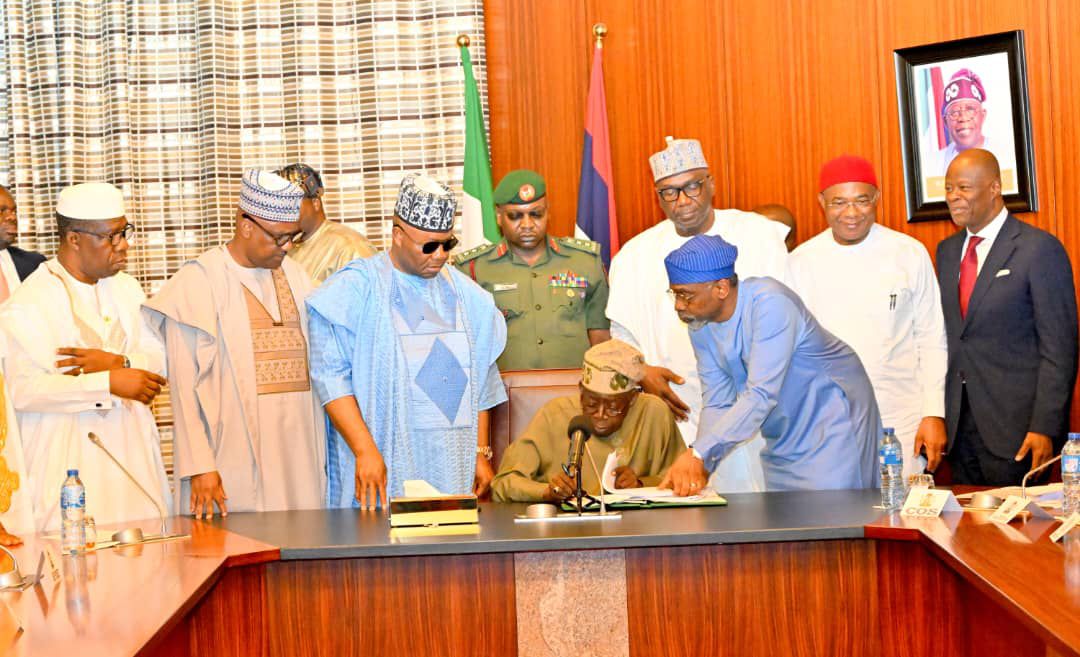
Nigeria stands on the brink of a transformative fiscal realignment. President Bola Ahmed Tinubu, in one of the boldest economic manoeuvres since assuming office, has signed into law four landmark tax reform bills, igniting far-reaching conversations across boardrooms, markets, and legislative halls. At a time when the economy faces mounting inflation, currency depreciation, and eroding investor confidence, this intervention signals a clear attempt to overhaul Nigeria’s historically fragmented and inefficient tax system.
This article explores the architecture of Tinubu’s fiscal reforms, their alignment with inflation control, the broader economic reforms accompanying them, and what this implies for businesses, households, and Nigeria’s economic trajectory.
Core Changes & Rationale
The reforms preserve Nigeria’s core tax structure but update it with clarity and relief mechanisms:
- Value‑Added Tax (VAT) remains at 7.5 %, but essential items like food, housing, healthcare, education, and transport are exempt — a move designed to ease the cost-of-living burden on low-income earners.
- Corporate Income Tax (CIT) remains at 30 % for large companies but will gradually reduce to 25 % from January 2026, aimed at attracting foreign investment and easing business pressures.
- Personal Income Tax (PIT) continues to provide progressive relief by exempting those earning below the national minimum wage, ensuring the poorest Nigerians are not burdened by tax.
- Small Business Exemption: Enterprises earning under ₦25 million annually are fully exempt from CIT, protecting Nigeria’s vast microenterprise sector and boosting economic inclusion.
- Tax Harmonisation: The reforms centralise collection functions by eliminating redundant and conflicting levies imposed across federal, state, and local jurisdictions, replacing them with a unified national framework under the Nigeria Revenue Service (NRS).
Institutional Reforms
The bills go further by restructuring institutional responsibilities:
- All federal tax-related agencies, including the Nigeria Customs Service, Nigerian Upstream Petroleum Regulatory Commission (NUPRC), and selected departments in ministries, are being repositioned under the NRS.
- This structural overhaul aims to eliminate overlapping functions, reduce bureaucratic inefficiencies, and ensure uniformity in enforcement and policy execution nationwide.
These provisions set the stage for a more transparent, streamlined, and citizen-focused revenue system.
On Thursday, 26 June 2025, at the Presidential Villa in Abuja, President Tinubu signed into law the Nigeria Tax Bill, the Nigeria Revenue Service (Establishment) Bill, the Nigeria Tax Administration Bill, and the Joint Revenue Board (Establishment) Bill.
This reform package represents the most ambitious overhaul of Nigeria’s tax regime since independence, targeting not just revenue generation but structural clarity, digitalisation, and policy coherence across all levels of government.
What Has Changed?
- One Tax Authority, One Voice: The establishment of the Nigeria Revenue Service (NRS) consolidates federal tax operations, removing fragmentation across customs, petroleum commissions, and revenue-generating MDAs.
- Simplification and Clarity: The Tax for Economic Growth Bill removes over 60 duplicative levies and arbitrary charges imposed by states or local governments.
- Protection for Low-Income Earners: Exemptions on VAT for basic items such as food, housing, healthcare, transport, and education.
- Tax-Free Status for SMEs: Businesses with annual revenue below ₦25 million are exempt from Corporate Income Tax.
- Digital-First Compliance: All tax processes are to be digitised by 2026, enabling faster filing, better accountability, and fewer middlemen.
Targeting Inflation: A Pragmatic Strategy
With inflation hovering around 24% year-on-year, driven by food prices, transport costs, and currency depreciation, Tinubu’s reforms could not be more timely.
Short-Term Inflation Bump?
Analysts at the Lagos Chamber of Commerce and Industry (LCCI) predict a short-term uptick in inflation — between 0.4 and 0.6 percentage points — due to the repricing of goods and the administrative friction of transitioning into the new system. However, this is expected to taper by early 2026.
The Real Target: Medium- and Long-Term Stability
Treasury Adviser Taiwo Oyedele, head of the Presidential Tax Reform Committee, was unequivocal: “If properly implemented, these reforms will bring Nigeria’s inflation to single digits within 24 months.” Key to this will be:
- VAT exemptions shielding consumers from the brunt of supply chain shocks.
- Revenue growth reducing dependency on central bank overdrafts and fiscal borrowing.
- Investor confidence returning due to predictable, transparent policies.
Naira Stability and Monetary-Fiscal Synergy
Following the central bank’s bold decision to unify exchange rates in 2024, these fiscal policies act as a stabilising brace. The Central Bank of Nigeria (CBN), now under a more disciplined mandate, has aligned interest rates to market realities. These tax reforms complement the monetary tightening, offering fiscal ballast to support the naira’s relative recovery.
The Private Sector Response: Wary But Hopeful
What Businesses Are Saying
For decades, Nigerian businesses have operated under a chaotic, often predatory tax structure. Multiple, overlapping levies from state and federal agencies created an operating environment laden with bribes, duplication, and uncertainty.
- The Manufacturers Association of Nigeria (MAN) lauded the consolidation under NRS, calling it “a long-overdue structural fix.”
- The Nigeria Employers’ Consultative Association (NECA) stated that “the reform signals a shift from punitive revenue collection to productive economic governance.”
- Small business owners, particularly in the tech and informal sectors, expressed cautious optimism about the removal of arbitrary levies and protection for micro-enterprises.
Foreign Investors React
Foreign Direct Investment (FDI) inflows, which dropped by 47% between 2021 and 2023, are now expected to rebound. International observers from the World Bank and IMF have already highlighted Nigeria’s fiscal direction as “strategically encouraging” in recent policy notes.
Governance and Structural Reform: Beyond Taxation
Tinubu’s tax reform is more than a fiscal policy. It is part of a broader governance reset. The reform goes hand in hand with other institutional transformations:
- Fuel Subsidy Removal: ₦11 trillion saved annually reallocated to infrastructure and social investment.
- Civil Service Audit: A payroll verification exercise has saved ₦280 billion by eliminating ghost workers.
- Customs & Ports Digitisation: Expected to boost revenue by ₦2.5 trillion annually through better tracking and less leakage.
- Oil Sector Clean-up: With a renewed anti-bunkering task force, Nigeria’s crude oil production has inched back to 1.5 million barrels per day.
The People’s Tax: What It Means for Citizens
Relief for Households
- Zero VAT on essential goods translates to real savings for average families.
- Protection of minimum wage earners under Personal Income Tax rules.
- Elimination of levies on informal market activities, especially for traders, artisans, and transporters in local economies.
Empowering the Informal Sector
With over 60% of Nigeria’s workforce engaged in informal employment, the government’s approach to exempt small operators from CIT until formalisation is a welcome gesture. Tinubu’s reform leans into inclusion rather than coercion.
States and Federal Alignment: Centre and Periphery in Dialogue
Harmonising the Tax Space
One of the most contentious areas of governance has been the tension between state and federal revenue agencies. Some states, particularly Lagos and Rivers, have historically insisted on retaining VAT collections.
Under the new arrangement:
- All VAT and PIT collections go to the consolidated tax pool administered by the NRS.
- States retain constitutional rights to consumption taxes, provided these don’t conflict with federal statutes.
- Revenue allocation will be merit-based, incorporating performance, compliance levels, and internally generated revenue.
While a few governors have expressed reservations, most have agreed to a transition committee set up by the Presidency to oversee integration.
Challenges Ahead: What Could Go Wrong
No policy is foolproof. While the potential for positive impact is significant, execution remains a major risk. Among the critical areas to watch:
- Bureaucratic Sabotage: Resistance from entrenched interests within MDAs may slow the rollout of reforms.
- Digital Infrastructure Gap: The shift to e-tax filing requires internet access, awareness, and systems security, which are not evenly distributed across Nigeria.
- Inflation Management: If subsidy savings are not efficiently redirected into social buffers, inflationary pains may mount for vulnerable groups.
- Political Will: Sustained reform requires cross-party consensus and executive-legislative alignment. The political elite must resist the temptation to dilute the reforms during election cycles.
Rollout Timeline: Strategic Phasing
The Presidency has mapped a detailed plan for phased execution:
| Phase | Timeline | Milestones |
|---|---|---|
| Pilot Rollout | Q3 2025 | Lagos, Abuja, Kano – NRS operations begin |
| Public Awareness | Q4 2025 | Tax education campaign via radio, TV, and online platforms |
| Digital Integration | Jan 2026 | All major taxes to be filed electronically |
| Performance Review | Q3 2026 | Mid-term audit of tax collection and leakage |
| Full Rollout | Dec 2026 | National NRS enforcement and application of new tax laws |
Conclusion: A Bold Attempt at Economic Sovereignty
Tinubu’s tax reform efforts will not fix Nigeria’s economy overnight. But for the first time in decades, the country has a coherent, business-friendly fiscal regime that is aligned with long-term development goals.
The potential rewards are massive: increased investor confidence, inflation control, equitable growth, and above all, restored public trust in the social contract.
Whether the plan succeeds depends not just on Tinubu’s will, but on the machinery of state, the patience of citizens, and the buy-in of the private sector.